Road Trip Recommendations Switzerland
Switzerland is particularly well suited for a road trip: short distances, excellent infrastructure, spectacular Alpine passes, crystal-clear lakes and charming cities are often just one to two hours' drive from one another. In this guide, we present three varied road trips (5 to 10 days) through Switzerland, including concrete route suggestions, tips on hiking and skiing areas, as well as a compact overview of the vignette, special tolls, heavy vehicle charge and car-carrying trains. Secure the right digital vignette for Switzerland before you set off, so you can use motorways and expressways conveniently.
Before you set off: planning is everything!
The ideal route for your road trip through Switzerland depends above all on the time available, the season and your personal priorities. You can choose from cities such as Bern, Lucerne and Zurich, impressive natural landscapes such as the Swiss National Park, Zermatt with the Matterhorn or Lake Geneva, as well as numerous hiking areas and ski regions. As a rough guide for your trip planning:
5–6 days: Focus on one region, for example Central Switzerland with Lucerne and Lake Lucerne, or the Bernese Oberland with Lake Thun and Lake Brienz.
7–10 days: Ideal for combining at least one larger city such as Zurich or Bern with hiking areas such as the Bernese Oberland, Valais or Graubünden.
10–14 days: Particularly suitable if you want to combine several regions, such as German-speaking Switzerland, Valais, Graubünden and Ticino, with side trips to lakes, passes and ski areas.
Tips from us

Our sample routes offer you a reliable foundation that you can, of course, flexibly adapt to your wishes. A proven rule of thumb for relaxed road trips is: plan for a maximum of 1 to 3 hours of driving time per day as well as two activities. This leaves enough time to enjoy the journey, rather than simply driving from one highlight to the next. When planning, also take the season and weather conditions into account:
May to October: Best time to travel for road trips focused on hiking, lakes and passes. Hiking regions such as the Bernese Oberland, the Valais with Zermatt, Graubünden with the Swiss National Park or eastern Switzerland are easily accessible during this period.
July and August: Peak season with lively cities and busy hiking trails. Popular regions such as Interlaken and the Jungfrau region, Zermatt or Lake Geneva are especially in demand at this time. Early reservations are recommended.
Late autumn and spring: Particularly suitable for cities, thermal baths, lakes and lower-lying hiking regions. Higher passes may already be closed, or still closed, during this period.
Winter (December to March): Ideal for combining a road trip with ski areas such as in the Vaud Alps and Lake Geneva region, in the Bernese Oberland, in the Valais with Zermatt and surroundings, or in Graubünden. Please note the winter equipment requirements as well as possible snow chain obligations and road closures at higher altitudes.
If you are travelling during school holidays or on long weekends, you should expect increased traffic especially on transit routes as well as around Zurich, Bern and popular hiking and ski regions.
Switzerland by car: getting there and starting points

Your starting point largely depends on where you live. However, some places are particularly well suited as a “hub” for a road trip:
Zurich: An international transport hub, ideal if arriving from Germany or by plane. A perfect starting point for routes into Central Switzerland, the Bernese Oberland or eastern Switzerland. (Read more: Zurich)
Bern: The capital is centrally located and ideal for combinations of the Bernese Oberland, the Mittelland and the Jura & Three-Lakes region. (Read more: Bern)
Lucerne: A charming city on Lake Lucerne and an ideal starting point for Central Switzerland, with mountains, lakes and panoramic mountain railways. (Read more: Lucerne)
Lake Geneva region: Well connected if arriving from France, and an excellent base for combining the Vaud Alps and the Lake Geneva region with Valais.
Graubünden / Ticino: Particularly suitable if the focus is on Alpine passes, the Engadin, the Swiss National Park or the Italian-influenced flair of Ticino, for example in the Verzasca Valley.
As soon as you use Swiss motorways and expressways, you will need a motorway vignette for vehicles up to 3.5 t GVW. The digital vignette, which is linked directly to your number plate, is particularly convenient. This way you travel without having to stick anything on and without the hassle of removing a sticker vignette.
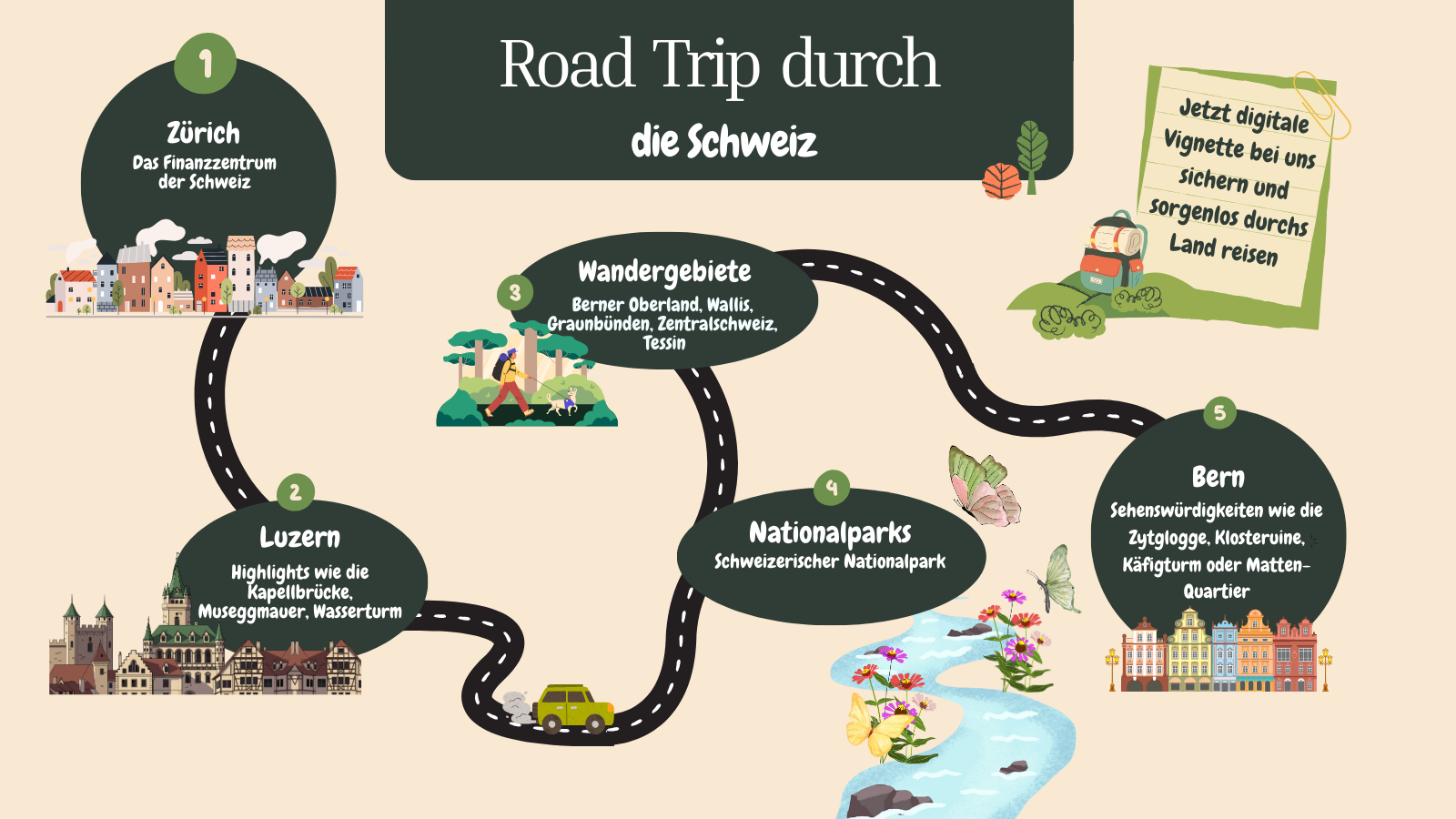
Road trip 1: Cities, lakes & the Bernese Oberland (7–10 days)
This route is particularly suitable if you are discovering Switzerland by car for the first time and are looking for a combination of city, lakes and mountains. It connects Zurich, Lucerne, the well-known Jungfrau region and Bern.
Zurich: City, culture and the Limmat (1–2 nights)
Lucerne & Lake Lucerne: Old town and panoramic mountains (2 nights)
Bernese Oberland (Interlaken region): Lakes and peaks (2–3 nights)
Bern: Federal capital and old town flair (1–2 nights)
Zurich (1–2 nights)

Start your road trip relaxed in Zurich. The old town, Lake Zurich, the lakeside promenades as well as the diverse culinary scene and numerous shopping opportunities make the city ideal for one to two days. You can find more information in our guide to Zurich.
For arrival by car, it is advisable to plan your arrival outside peak hours, as traffic can be heavy on the approach roads and in inner-city districts, especially in the morning and evening. Many hotels have their own car parks or parking spaces. Alternatively, you can use park-and-ride car parks on the outskirts of the city and take public transport into the centre.
Lucerne & Central Switzerland (2 nights)
From Zurich, the route continues to Lucerne. The Chapel Bridge, the Musegg wall and the city's direct location on Lake Lucerne make it a special highlight. Combine your stay with a boat trip and an excursion to one of the surrounding mountains.
In our article on hiking areas, you will find suggestions for popular excursion destinations.
Bernese Oberland (2–3 nights)

The journey then continues towards the Bernese Oberland, for example to the Interlaken region between Lake Thun and Lake Brienz. From there you can reach well-known places such as Grindelwald, Lauterbrunnen or Kleine Scheidegg. Depending on the season, you can choose between hiking, mountain railways, paragliding or winter sports.
In our guide to hiking areas as well as to the ski areas in Switzerland, you will find further inspiration.
Bern (1–2 nights)
A stay in Bern makes for a fitting conclusion. The medieval old town, which is a UNESCO World Heritage Site, the Aare loop and the view from the Rose Garden provide a relaxed end to your road trip. Spend one day strolling through the city and visiting cultural sights, and the other on a side trip to the Mittelland or the Jura & Three-Lakes region. You can find more information in our article on Bern.

Road trip by car
Driving times between the individual stages are usually 1 to 2 hours. Many stretches run along motorways, for which a motorway vignette is required. Alternative routes via country roads are particularly scenic. Although they take more time, they offer deeper insights into smaller towns and valleys.
Road trip 2: Lake Geneva, the Vaud Alps & Valais (6–9 days)
This road trip is aimed at anyone who wants to combine vineyards, lakes and high peaks. It is ideal if you prefer to change location less often while still experiencing a varied mix of nature, indulgence and Alpine panoramas.
Lake Geneva region (e.g. Lausanne/Montreux): Lake and vineyards (2 nights)
Vaud Alps: Mountains and panoramic views (1–2 nights)
Valais (Zermatt & surroundings): Glacier landscapes and the Matterhorn (2–3 nights)
Fribourg region or the Mittelland: Return journey with a city trip (1 night, optional)
Lake Geneva region (2 nights)

Start in Lausanne or Montreux. The Mediterranean-like flair, the lakeside promenades and the vineyards of Lavaux offer an ideal introduction. Take a boat trip on Lake Geneva or enjoy a relaxed panoramic hike through the vineyard terraces. You can find further ideas in our article on hiking areas.
Vaud Alps (1–2 nights)
From the towns on the lake, the route leads up into the Vaud Alps. Well-known destinations such as Les Diablerets or Leysin offer hiking trails, viewpoints and, in winter, attractive ski areas. Depending on the season, you can combine mountain railways, easy high-altitude trails or days of skiing.
Valais with Zermatt (2–3 nights)
Next comes Valais, a particularly appealing region for mountain lovers. Zermatt with the Matterhorn in particular is an outstanding destination. Allow enough time for panoramic hikes, glacier experiences and mountain railways. In our articles on hiking areas and ski areas, you will find concrete suggestions.

Depending on the route, using a car-carrying train can be worthwhile, for example at the Lötschberg or Furka. Your vehicle is loaded onto a train while you remain comfortably seated in your car as you pass through tunnel sections. Tickets for car-carrying trains are not covered by the vignette and must be paid for separately. You can find more information on car-carrying trains in our guide.
Fribourg region or the Mittelland (1 night, optional)
On the way back, a stay in the Fribourg region or the Swiss Mittelland is a good option. Historic towns, rolling hills and lakes provide a pleasant conclusion. You can find further inspiration in our article on hiking areas in Switzerland.
Road trip by car
The distances between the individual stops are usually 1 to 3 hours of driving time. You will likely use both motorways and mountain roads. In Alpine regions, you should always take steep gradients, tight bends and possible winter closures into account. You can find information on the vignette and other types of tolls in our detailed overview of tolls in Switzerland.
Road trip 3: Graubünden, the National Park & Ticino (8–10 days)
The third road trip is aimed at nature lovers who want to get to know eastern Switzerland, Graubünden and Ticino more intensively. Alpine valleys, passes, lakes and Mediterranean flair provide plenty of variety.
Eastern Switzerland (e.g. Appenzell region / Lake Constance): Hills, cheese and views (1–2 nights)
Graubünden (e.g. Engadin): Mountains and lakes (2–3 nights)
Swiss National Park: Pristine nature and hiking trails (1–2 nights)
Ticino (e.g. Locarno, Verzasca Valley): Southern flair (2–3 nights)
Eastern Switzerland (1–2 nights)

Start your journey in eastern Switzerland, for example in the Appenzell region or on Lake Constance. Gentle hills, traditional villages and scenic peaks provide ideal conditions for easy hikes. You can find further ideas in our article on hiking areas in Switzerland.
Graubünden (2–3 nights)
The route then continues to Graubünden. Well-known places such as Davos, Arosa or St. Moritz offer Alpine panoramas, lakes and, in winter, attractive ski areas. Depending on the season, you can choose between hiking, mountain biking, winter sports or panoramic train rides. Our guide to hiking areas in Switzerland will help you with your planning.
Swiss National Park (1–2 nights)
A special highlight is the Swiss National Park, the oldest protected area of its kind in the Alps. Here you can expect marked hiking trails, strict nature conservation regulations and good opportunities to observe wildlife. Allow at least one full day for this. Detailed information can be found in our article on the Swiss National Park.
Ticino with the Verzasca Valley (2–3 nights)

The journey concludes in Ticino. Around Locarno, Ascona or Lugano, you can expect Mediterranean flair, palm trees and lakes for swimming. An excursion to the Verzasca Valley, with its turquoise water and traditional stone villages, is particularly recommended. You can find concrete tour suggestions in our article on hiking areas in Switzerland.
Road trip by car
Driving times are usually between 45 minutes and 2.5 hours and often run along winding mountain roads. Car-carrying trains such as the Vereina tunnel can also be a sensible option for getting from one valley to another more quickly and regardless of weather conditions. Please note: car-carrying trains are subject to a fee and must be paid for independently of the vignette. In addition, some Alpine pass roads and tunnels, such as the Munt-La-Schera tunnel, are subject to a special toll and must be paid for separately.
Toll guide Switzerland
Are you unsure whether you need a vignette for your road trip through Switzerland, or which additional fees might apply? In Switzerland, four points in particular are relevant: the motorway vignette, the heavy vehicle charge (HVF), special tolls and car-carrying trains.
Motorway vignette for vehicles up to 3.5 t GVW: A vignette is required on motorways and certain expressways for cars, motorcycles and most motorhomes up to 3.5 t GVW. It is available both as a sticker vignette and as a digital vignette. Purchase your digital vignette for Switzerland from us now.
Annual vignette only: Unlike in many neighbouring countries, Switzerland offers only an annual vignette. Short-term or 10-day vignettes are not available.
Special tolls: Some tunnels and passes, such as certain Alpine crossings or privately operated tunnels, are subject to a special toll. These fees are not included in the vignette and must be paid separately.
Heavy vehicle charge (HVF): For vehicles over 3.5 t GVW, the performance-related heavy vehicle charge (HVF) applies. It is generally collected via on-board units or registration and billing systems, and replaces the standard motorway vignette.
Car-carrying trains: Car-carrying trains such as the Lötschberg, Furka or Vereina shorten travel times and bypass mountain passes. They are convenient, but always come at an additional cost on top of the vignette or HVF.
Checks and fines: Driving without a valid vignette or HVF payment can result in significant fines. Checks take place at the border, at rest areas and in moving traffic.
You can find a comprehensive overview in our guide to tolls in Switzerland. You will also find detailed information on the various car-carrying trains and tunnels in our article on car-carrying trains (vehicle transport). Feel free to also use our guide to vehicle classes to find out whether you need a digital vignette or have to pay a heavy vehicle charge.
Validity period of the digital vignette for Switzerland
Switzerland only offers an annual vignette. You can choose between a sticker vignette and a digital vignette. The digital version is linked to your number plate and can be conveniently ordered online, with no sticking required.
If your road trip covers several countries, you will need a separate product for each vignette country. We offer digital vignettes for several countries, including Austria, Czech Republic, Slovenia, Romania, Hungary, Switzerland and Slovakia. This allows you to plan your route conveniently in advance.
Vignettes are country-specific
Please note that the digital vignette for Switzerland is valid only in Switzerland. Different toll systems may apply in neighbouring countries such as Austria, Italy, Germany, France or Liechtenstein, some with a vignette, others with distance-based tolls.
Why our digital vignette is the right choice
DMC Digitale Maut Consulting GmbH makes your journey through Switzerland particularly straightforward:
Fast & digital: The vignette can be ordered online in just a few minutes, with no sticking and no postal delivery required.
Linked to your number plate: Checks are carried out digitally via the number plate; no sticker is required.
Planning security: Ideal for organising your annual holiday or several trips to Switzerland well in advance.
Several countries from a single source: Since 2019, we have offered digital vignettes for Austria, Czech Republic, Slovenia, Romania, Hungary, Switzerland and Slovakia. This is particularly convenient for longer road trips.
Email support in 15 languages: Our team is happy to assist you with questions about tolls, vehicle classes and the right vignette.
Order your digital vignette for Switzerland now and avoid unnecessary detours or fines.
Practical tips for on the road

To make sure your road trip through Switzerland goes smoothly, you should take a few practical aspects into account:
Timing: If possible, avoid peak traffic times on Fridays, Sundays and at the start and end of holiday periods. Otherwise, traffic jams can occur on transit routes such as north-south corridors.
Traffic rules: Observe speed limits and blood alcohol limits. Find out in advance about the traffic rules in Switzerland, particularly regarding speeds on motorways, country roads and in towns.
Parking in cities: Parking spaces are often scarce in Zurich, Lucerne, Bern and other larger cities. If possible, use multi-storey car parks, park-and-ride facilities or hotel car parks.
Nature and protected areas: Stay on marked trails, take your rubbish with you, and observe the signage in national parks and protected landscape areas such as the Swiss National Park.
Camping: Wild camping is restricted or prohibited in many places. Find out in advance about official campsites or pitches.
Weather conditions: The weather can change quickly in the Alps. Pack in layers and bring a rain jacket and sturdy footwear.
Winter equipment: In winter, winter tyres, snow chains and observing relevant signage are important. Passes may be closed. Check the current situation before setting off.
Safety on the road: Take regular breaks, use rest areas, and only stop where it is expressly permitted.
The Europamaut team wishes you a pleasant journey
We wish you a pleasant journey to Switzerland and lots of enjoyment on your exploration of the country's impressive natural landscapes. Please make sure to find out about the applicable toll regulations in good time. In addition, our route planner is available to help you plan your trip optimally and display the relevant toll products. If you have any questions, we will of course be happy to help. Feel free to contact us at any time by email.
